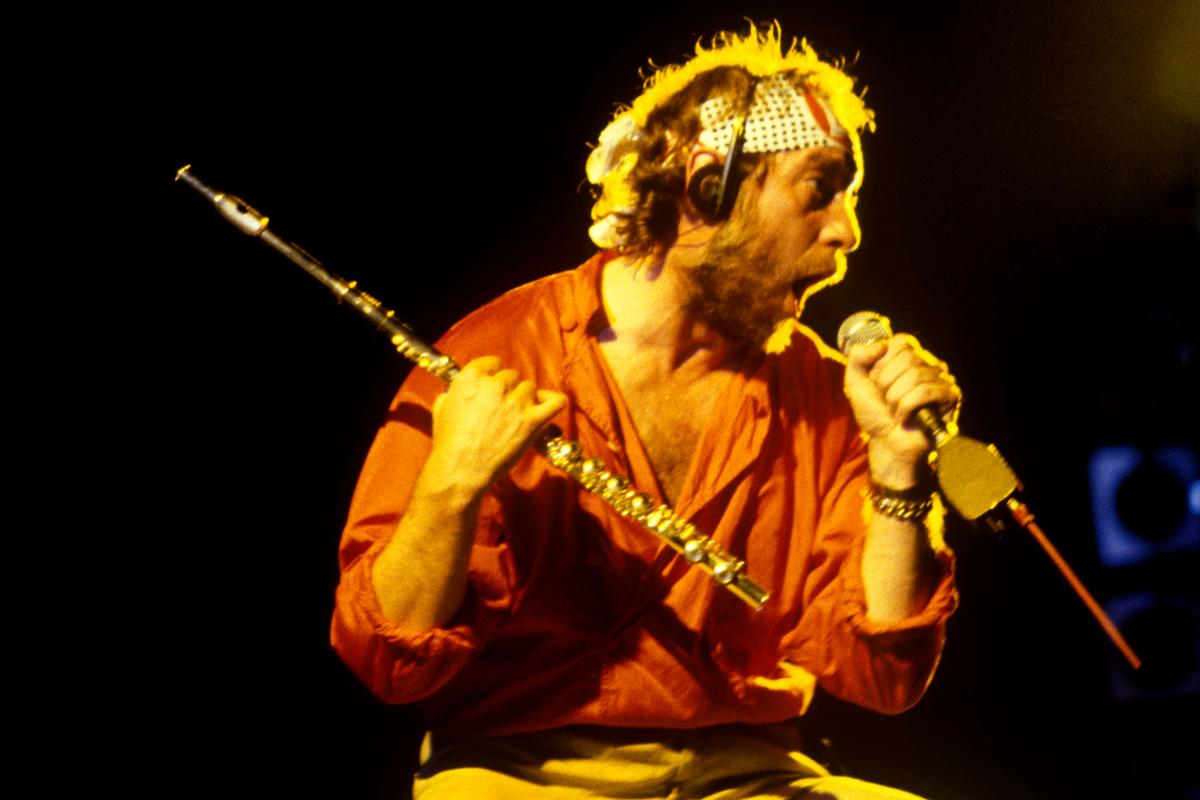
Like many of their contemporaries, Jethro Tull embraced new technology and the changing tone of music as they continued making music at the dawn of the ’80s.
But as the band’s mastermind, flautist and vocalist Ian Anderson lays out in the conversation below, their evolution had begun long before that and in fact, was a constant element of their process. So while the albums they made at the beginning of the decade and beyond shifted in more of an electronic, synthesized direction, the focus remained squarely on the songs and the quality of the songs, just like it had always been.
Anderson continues to revisit his work from across the decades with expansive box sets, featuring bonus material, live recordings and new presentations for the albums themselves. The latest set takes stock of 1984’s Under Wraps album and his own solo album, 1983’s Walk Into the Light. During a long conversation that you can listen to on the UCR Podcast, he unpacked the time period for us. You can preview the interview with a few excerpts below, including his thoughts on when fans can expect the next new Jethro Tull studio album.
Let’s start with your memories of working on Under Wraps. There was a lot going on.
Well, from 1982, the changing landscape of music technology was going to impact in some way, and I felt that either I could largely ignore it and continue in a in a very traditional analog world of Fender guitars and Hammond organs and acoustic instruments like the flute and the guitar, my acoustic guitars and so on.
But it felt like a harmless attempt to explore the possibilities that might come along with that new technology from a creative standpoint. So the moving from the simplest early drum machines to programmable computer-based drum or rhythm type of organizing of the elements from the band point of view, were interesting. And of course, particularly in keyboards, things were changing dramatically, where the earliest synthesizers were giving way to polyphonic and more programmable options.
So it seemed like an opportunity to try and utilize some of those different sonic possibilities in the songs that I was writing. And the songs were very much written around that technology, particularly working with Peter Vettese, who I’d worked with on the Walk Into the Light solo album in 1983. So ’84 was a move within the Jethro Tull context and with the Jethro Tull band members to utilize that technology [to] see where it might take us. I think the result was a very good blend of traditional analog, real-time recording and the programmable digital elements that we brought into play.
I think it’s important to remember that the album was recorded with all the musicians actually playing their instruments. The only thing that was programmed and we were playing too, were the electronic drums. Other than that, everything was being played as it always had been. I mean, most of the guitar, for example, was probably recorded on a on a 15-watt Marshall little mini amp in the studio and Dave Pegg was playing one of his usual bass guitars plugged straight into the back of the mixing console. We were playing in real time, we were playing as a band and we rehearsed the music.
Knowing that much of it would be music we could perform live on stage, that was an important part of the of the way we worked, that indeed we did go on to play much of that music, not all of it, but certainly much of it, we performed live in concert during the next year or so. So it was very much a Jethro Tull album. It just had some of those elements that made it different to what we’d done before and musically, it had a different nuance because of the technology in which the songs were being written and arranged. So it it wasn’t as if I was taking songs that I’d written a couple of years before or working in some absolute musical sense and then saying, “Right, now, I’ll apply those songs to to the recording process using the new technology.”
Listen to Ian Anderson on the ‘UCR Podcast’
These were songs that were all really written with the technology there in front of me, and particularly Peter Vettese, with whom I worked closely on the realization of those songs. Musically, not lyrically, of course, but musically so that the band could develop within those musical arrangements, as they were being devised anyway.
But it’s a great album I always liked. Some of the songs, I felt, were really amongst the best songs that I played. And I would say that from a guitar standpoint, I would rate the album as being from a guitar performance, both Martin Barre’s lead guitar and Dave Pegg’s bass guitar, I mean, it was amongst their very best work ever and it was demanding to play. But, you know, they entered into it with a good heart and a good spirit. And I think they gave really, really good performances.
Watch Jethro Tull’s ‘Lap of Luxury’ Video
With thisnew box set, we get two new mixes of both Under Wraps and Walk Into the Light. What was the experience of going back to these records in that way for you?
Well, I’ve revisited the the albums in the process of deciding how we would embark upon doing remixes or replacing original drums and and there were two or three options available to me and the record company. After some discussion and a few examples that were prepared as potentially the way forward, then I decided to work with within the familiar relationship with Bruce Soord, the writer and producer and performer, with The Pineapple Thief, a progressive rock band of more contemporary times.
Bruce is a very intuitive [collaborator] rather like Steven Wilson. You know, he’s a very intuitive co-conspirator when it comes to bringing these things alive 20, 30, 40 years after they were originally recorded. And I think that’s something, you know, I feel very blessed with, those relationships with people who it would not be wrong to call them Jethro Tull fans. The fact that they happen to be, you know, notable musicians and producers in their own right, just is of benefit. But I think they both have a really good feel for Jethro Tull music and a high level of respect for Jethro Tull music in the historical sense. So they’re, they’re both great people to work with.
It was interesting as a music fan to watch how bands evolved as they got into the ’80s. With A and also, TheBroadsword and the Beast, you and Jethro Tull go full on into it with synthesizers and drum machines. What were some of the things you were hearing as a musician and perhaps also, as a music fan that kind of led you in that direction with those albums prior to these two records?
Well, it goes back to 1972 and the recording of Thick as a Brick, when we started using the very earliest monophonic synthesizers. You know, obviously Moog synthesizers had been developed in the USA, but there were one or two European small companies that developed synthesizers too and we did utilize [some of that] on Thick as a Brick in a few, few little places here and there, one of those early synthesizers, on one occasion, with the synthesizer generating sounds that had been derived from my flute playing.
READ MORE: How Jethro Tull Tried to Out-Prog Everyone on ‘Thick as a Brick’
So I was playing the flute, but what was coming out and recorded on the tape, was a synthesizer sound, which was interesting to do. But I came to the conclusion fairly quickly that I preferred a flute to sound like a flute rather than sound like, you know, a monophonic line of a typical two-oscillator synthesizers as they were back then. But it waspart of that experimentation [with] digital technology [that] had also been creeping in, in regard to effects processing, digital echoes, tape repeats and those sort of things that were beginning to come about.
And so really, from, you could say, from ’72 onwards, you know, we were occasionally using that technology as part of the recording process. By the time we got to the latter part of the ’70s, using synthesizers for both of the keyboard players that were playing in the latter part of the ’70s, then we used that stuff. And it was sometimes interesting sounds, sometimes not so interesting.
The very early ’80s, kind of synthesizer sounds of particularly the British bands that latched on to that technology and made their music. I’m thinking of people like Gary Numan and Soft Cell, that was the era of what was thought as being a whole new musical direction, but it had grown organically out of music that had begun some 10 years before — or the technology that had begun 10 years before.
When it came to our own music of that mid-period of the ’80s, then it moved a little more in that direction. But it wasn’t the most important element. It was just the sonic landscape had changed, but not fundamentally, because, you know, four-fifths of the noises that you were hearing were still being played by human beings in real time. It was people sitting, actually playing their instruments and and hopefully managing to do takes that were substantially large chunks of music, not just a few little short lines at a time.
It was done in quite a human way. I think that’s categorized Jethro Tull recordings since the very beginning. [There was always] a consciousness that we should try to record them as we would play them live on stage and so we would rehearse them in the arrangement process. When it came to actually recording, then as far as possible, we would try to play together. Sometimes, of course, that’s not especially…if you’re an acoustic musician like me, you can’t really do do that live in the studio. You know, you tend to either have to do it to begin with and other people play along to the acoustic instruments. Or you add the acoustic instruments after the band have played their electric instruments and laid down the basic track. And the same thing applies to vocals, of course,
READ MORE: Jethro Tull, ‘Curious Ruminant’: Album Review
You’ve got a lot of Jethro Tull shows happening presently and for the rest of the year. How much have you started thinking about the next album?
Well, I have a growing and gradually settling direction to work to, you know, a few little things that I’ve doodled in terms of lyrics and music, but I’m not at that point yet where I’m going to set aside the time to very deliberately write all of the album and record it. That’s a little bit ahead of me. I mean, months away, because I’m committed anyway with tours and other things that I’m doing. I’m pretty busy all of this year and indeed, already in 2027. I mean, there are quite a few things. We don’t list them on our website because it’s too early, the tickets are not on sale, so you don’t advertise these things until people can actually go out and buy a ticket.
I have a couple of trips to make in the next few weeks to go and visit some couple of places that that that will be right at the end of 2027 in December, just before Christmas. So you know, that’s a year and a half away. I’m being pretty brave and saying, “Yeah, well, you know, a year and a half from now, I’ll still be alive and kicking and and doing a particular show with a particular set list.That’s quite brave at my age, to be thinking positively about doing that. And hopefully, from a medical standpoint, I will be able to do that and without fear of cardiac arrest or boredom.
READ MORE: Jethro Tull Schedules Massive 2026 Tour
Find more details regarding Jethro Tull: Under Wraps: The Unwrapped Edition at Rhino’s official website.
Jethro Tull Under Wraps box set
Jethro Tull Albums Ranked
Few bands have evolved in such a distinct way.
Gallery Credit: Ryan Reed