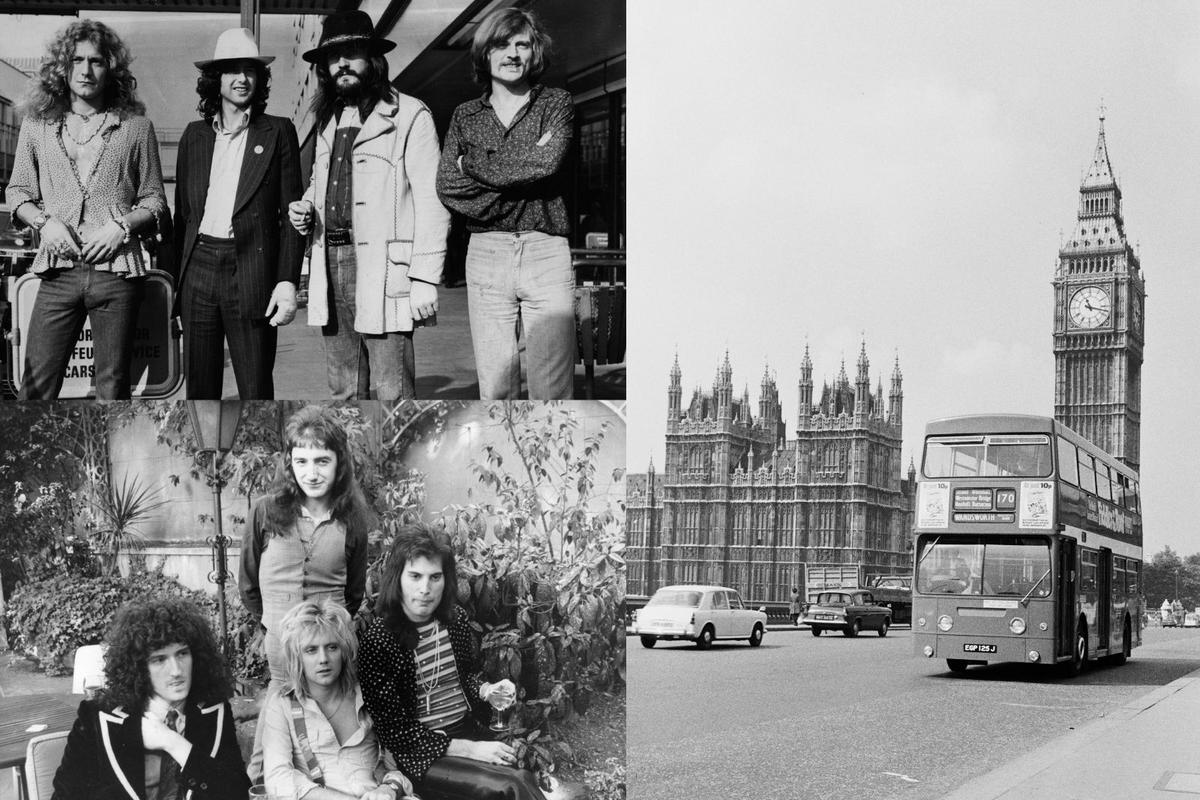
As the ’60s came to an end in London, so too did a certain vision. Arguably one of the biggest schisms in rock history took place at this time: the breakup of the Beatles. After close to a decade of dominating the world, the Fab Four went their separate ways and barely looked back.
But in their place came a new cohort of ground-breaking bands, several of whom had gotten their starts in the ’60s and were only just beginning to experience a taste of fame of fortune.
“You can never say what’s going to last for how long,” Robert Plant of Led Zeppelin said in 1970 (via The Guardian), “but it’s so refreshing to all of us to be able to sit down and come up with these things, with everybody having ideas that they’ve never had before, everybody being a part of a finished article, and it’s good.”
Whatever success Zeppelin had achieved in the late ’60s was swiftly and undeniably eclipsed by their success in the ’70s, traveling by private jet, renting out entire blocks of the world’s most famous hotels and generally embodying the rock ‘n’ roll lifestyle.
And they most definitely were not the only London-based band to reach this level of prominence. Below, we’ve narrowed it down to the “big 4.”
1. Queen
It really didn’t take very long for Queen to become international superstars. Their self-titled debut album came out in 1973, a release described by Rolling Stone at the time as “superb.”
Then came Queen II in 1974, Sheer Heart Attack later that same year and A Night at the Opera in 1975, the last of which contained “Bohemian Rhapsody,” a track that spent a whopping nine weeks at No. 1 in the U.K. Even more success followed with 1977’s News of the World, featuring “We Will Rock You” and “We Are the Champions.” By the end of the ’70s, Queen was one of the most popular bands in the world and there was still more to come.
In many ways, Queen, and more specifically their lead singer Freddie Mercury, represented a generation of Londoners that was unlike those past. They were some of the first to utilize music videos as promotional material that further expanded their reach, made theatrical music that translated incredibly to the live stage and in Mercury was a frontman that was entirely unafraid of being himself in an era when being “different” from the rest of society wasn’t always appreciated. Queen only consisted of four, albeit very talented people, and yet their layered sound and approach to overdubbing made them seem like an entire orchestra.
2. Led Zeppelin
When one thinks of ’70s rock ‘n’ roll, Led Zeppelin should immediately come to mind.
Formed in 1968 in London, the foursome — Robert Plant, Jimmy Page, John Bonham and John Paul Jones – soon took the world by storm with a heavy sound that drew from blues, rockabilly, middle eastern and folk influences. Page had already begun honing his talent for song arranging in the Yardbirds, while Plant’s voice was the sort that blew away audiences from the moment he opened his mouth. (At one point, Rolling Stonewrote that Plantsings notes “that only dogs can hear.”) Seven of Led Zeppelin’s nine studio albums went to No. 1 in the U.K. – their fourth release, 1971’s Led Zeppelin IV, is one of the best-selling albums in history. And that’s to say nothing of their incredibly popular tours that drew tens of thousands of people.
Led Zeppelin’s catalog was both finely tuned and highly experimental. A 20-minute drum solo on one song? Sure, why not? Open tunings in an extended jam session? Yes, please. Zeppelin somehow combined British, Celtic and American sounds into one, guitar-driven space.
Beyond just their music, Led Zeppelin was the ultimate rock band in terms of how they presented themselves to the world and their hedonistic approach. Musicians of the ’60s weren’t exactly the straight and narrow sort, but Zeppelin, with their own private jet and reputation for debauchery, took things to a new level.
“Admittedly everyone in the group may have a different perspective on events but most other people take outrageous license with this stuff,” Page recalled to Mojo in 2014. “Yes, like I said we were living it, but for me – and this will be the epitaph of it all – it was about a bunch of musicians who learnt about rock ‘n’ roll, blues and serious acoustic guitar players and lots of other areas, and ended up creating a textbook for musicians. That’s the lifetime achievement right there. It’s not some sort of scandalous tit-bit, it’s about the real serious weight of it, about what the music really means. That’s it.”
3.Pink Floyd
Like other bands on this list, Pink Floyd was operating in the ’60s, ’80s and beyond, but it was the ’70s that saw their peak.
By that point, their eclectic cofounder Syd Barrett had left the band, but his influence continued to permeate their sound. In October of 1970, they released Atom Heart Mother, their first No. 1 album. Even then, Pink Floyd was taking elements of ’60s psychedelia and morphing it into something longer, more alien and existentialist. There were a number of terms used for it — acid rock, proto-prog, space rock, etc. — but one thing was abundantly clear: Pink Floyd’s music did not adhere to traditional radio-friendly rules and it leaned more toward operatic themes than straightforward rock ‘n’ roll.
“There is a general feeling, I suspect, in the group that music that really works is music that touches your emotions and triggers off something unchanging, some kind of eternal response,” Roger Waters said in a 1970 interview. “Like, it’s really difficult to describe your reactions to a piece of music that hits you, gives you a particular kind of feeling, a particular kind of feeling that transcends the normal ups and downs and ins and outs.”
Pink Floyd’s music evidently gave lots of people lots of feelings. Every one of their albums released in the ’70s went into the Top 10 in the U.K. — The Dark Side of the Moon (1975) and The Wall (1979) are still among the best-selling albums of all time.
4. The Clash
It was not easy, but we decided that the Clash was the best band to represent the movement that was punk rock in ’70s London. Many, many others were active and highly influential during this period of time, but the Clash was perhaps the most important.
While bands like the Sex Pistols and the Damned were making very exciting music, the Clash was more nuanced in their approach, largely thanks to the songwriting partnership of Joe Strummer and Mick Jones. They wrote about their own lives in London, as well as the broader political world around them, encouraging listeners to know their rights and stand up for themselves when necessary. They brought in elements of ska, reggae, funk and rockabilly, making for a raucous yet concentrated sound that was part punk, part new wave and extremely London.
“The Clash, more than any other group, kick-started a thousand garage bands across Ireland and the U.K.,” the Edge once said of them. “The social and political content of the songs was a huge inspiration, certainly for U2. It was the call to wake up, get wise, get angry, get political and get noisy about it.”
Unlike Zeppelin or Queen, giants of the industry then, the Clash represented the working kids of the U.K. who knew there was a fairer way of life out there — one need only to speak up.
The Best Song From Every Led Zeppelin Album
Choosing the best song isn’t easy, since many of their LPs come together as a piece – and they include so many classic tracks.
Gallery Credit: Michael Gallucci