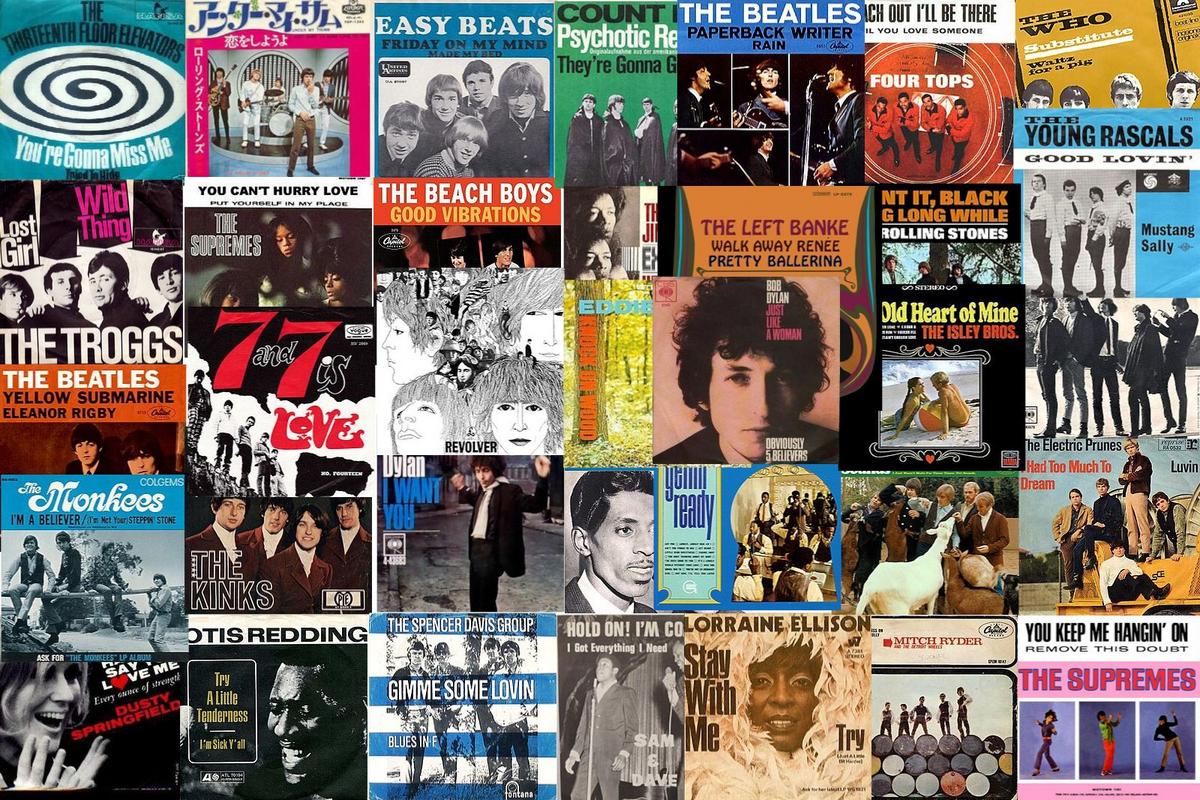
If 1965 was the year when pop and rock music started to take its first baby steps toward adulthood, as more artists began to explore albums as defining statementsrather than collections of hit singles and hastily recorded cover songs, then 1966 was the year pop grew up.
In the list below of theTop 40 Songs of 1966, popular music was on the threshold of bigger and greater things. Right around the corner were artists willing to shuffle expectations; the 45 single was no longer limited to two and a half minutes of radio ear candy. With records taking chances— in sound, length and content— the decade had turned a corner toward brighter horizons.
Several of the artists below had busy and productive years: The Beach Boys, the Beatles and Bob Dylanall released their greatest albums and assorted singles in 1966, so it’s no surprise they appear here more than once. But they were just the tip of the bounty of the musical riches offered in this pivotal year.
40. Otis Redding, “Try a Little Tenderness” (From Complete & Unbelievable: The Otis Redding Dictionary of Soul)
“Try a Little Tenderness” was first recorded in 1932 by the Ray Noble Orchestra and later covered by luminaries such as Bing Crosby and Frank Sinatra.Otis Redding‘s version, 34 years later, became the standard.Backed by the impeccable Booker T. & the MG’s, the soul music giant transformed the somewhat maudlin ballad into a sweat-drenchedR&B workout that builds to the point of collapse, then ultimate release.
39. The Monkees, “I’m a Believer” (From More of the Monkees)
Written by Neil Diamond and released as the Monkees‘ second single in November 1966, “I’m a Believer” quickly shot to the top of the chart, becoming the group’s second simultaneous No. 1 in just a couple of months. It stayed at that position for seven weeks, carrying the Monkees’ second LP, More of the Monkees, to No. 1 in the early months of 1967 and remained there for 18 weeks as the linchpin to Monkeemania.
38. The Easybeats, “Friday on My Mind” (From Good Friday)
Pioneers in the Australian rock scene, the Easybeats had racked up a handful of local hits before theraucous “Friday on My Mind” gave them an international smash. The song reached the Top 20 in the U.S., Top 10 in the U.K. and No. 1 in several countries, including theirsecond Australian chart-topper.Guitarists George Young and Harry Vanda would later guide and producea band featuringYoung’s brothers, AC/DC.
37. The Who, “Substitute”(From single)
The Who had already proven themselves adept at more than just three-chord guitar rock on their debut album,My Generation. With the release of their 1966 single “Substitute,” which arrived three months after the LP, theywent into full pop mode.Lyrically inspired bySmokey Robinson and the Miracles’ summer 1965 single “The Track of My Tears,””Substitute” became the band’s fourth straight U.K. Top 10.
READ MORE: Top 40 Songs of 1965
36. Sam & Dave, “Hold On, I’m Comin'” (From Hold On, I’m Comin’)
“Hold On, I’m Comin'” was written on the spot by the songwriting team of Isaac Hayes and David Porter as Hayes was waiting for Porter to leave the Staxrestrooms during a writing session. The suggestive tone of the song’s title worried some radio programmers, so it was changed to “Hold On! I’m A Comin'” on the record labels. The single became Sam & Dave’s first Top 40 hit and first No. 1 on the R&B chart.
35. The Rolling Stones, “Under My Thumb” (From Aftermath)
Like many British Invasion groups, the Rolling Stones entered 1966 with wide-eyed intentions of reshuffling their playbooks.Aftermath, the first of their albums to move entirely beyond the blues- and R&B-based recordings of their career’s first stage, is filled with moments of restless experimentation.“Under My Thumb,” with Brian Jones supplying the main riff on marimba, is at the top of the LP’s many achievements.
34. The Kinks, “Sunny Afternoon” (From Face to Face)
“A Well Respected Man” from 1965 had positioned Ray Davies and the Kinks at the front line of artists moving beyond theirprevious successes. After a string of hit singles built on distorted electric guitar riffs and the boy-girl themes typical of the period, Davies began writing more dissenting songs with British music hall shadings and sly wordplay. “Sunny Afternoon” continues this path,lining their industrious fourth LP, Face to Face.
33. Mitch Ryder and the Detroit Wheels, “Devil With a Blue Dress On & Good Golly Miss Molly” (From Breakout…!!!)
Pairing two cover songs— Shorty Long’sbluesy “Devil With the Blue Dress” and Little Richard’s stomper “Good Golly Miss Molly”— Mitch Ryder and the Detroit Wheels’ 1966 medley reached No. 4, the highest position for either song’s earlier incarnations. The band’s rowdy version inspired Bruce Springsteen‘s showstopping “Detroit Medley,” a centerpiece of his ’70s-era concerts. The songwas a part of Ryder’s shows for years.
32. Buffalo Springfield, “For What It’s Worth” (From single)
Stephen Stills wrote “For What It’s Worth”about the November 1966 Sunset Strip curfew riots and was released shortly afterward. But Buffalo Springfield‘s breakthrough songeventuallyended upas an anti-war anthem thanks to its open-ended chorus of “Stop, hey, what’s that sound? Everybody look what’s going down.” The Top 10 hit was issued two months after the band’s debutLP, but was added tosubsequent pressings.
31. The Rolling Stones, “Paint It, Black” (From Aftermath)
Brian Jones was feeling his way around a sitar when he hatched the initial melodic line that courses through “Paint It, Black.” George Harrison had introduced the Indian instrument to Western pop music the year before in the Beatles’ “Norwegian Wood (This Bird Has Flown),” but the Rolling Stones were the first band touse the instrument in aNo. 1 single. Shades of looming psychedelic rock can be heard here, too.
30. The Beatles, “Eleanor Rigby” (From Revolver)
If there was any doubt that pop music was heading into brave new directions in 1966, the arrival of “Eleanor Rigby” that summerconfirmed it.Accompanied by only a double string quartet (John Lennon and George Harrison provided backing vocals), Paul McCartneyrecited a song about despairing loneliness … hardly material found in the pop landscape at the time. Like all of theRevolverLP, it was ahugestep forward.
29. The Troggs, “Wild Thing” (From From Nowhere… The Troggs)
“Wild Thing” was written by American Chip Taylor (who also penned “Angel of the Morning”) and released as a single by the obscureNew York City pop-rockgroupthe Wild Ones in 1965, but failed to chart. British band the Troggs covered the song the following year andhad their first U.K. hit (No. 2) and only U.S. No. 1. “Wild Thing,” with its garage-rock racket and snarling vocal, helped set the stage for punk a decade later.
28. ? and the Mysterians, “96 Tears” (From 96 Tears)
Garage rock first emergedin late 1964 and into 1965, but developed into its present-day proto-punkform in1966, when bands on both sides of the Atlanticcame upwith new, more aggressive sounds.? and the Mysterians hailed from Michigan, but their Vox Continental organ-driven songshad coast-to-coast appeal. With knotted vocals and a deceivingly simple melody, “96 Tears” went to No. 1, spurring arising revolution.
27. The Spencer Davis Group, “Gimme Some Lovin'” (From single)
With 18-year-old Steve Winwood out front, “Gimme Some Lovin'” announced both the singer and keyboardist andthe Spencer Davis Groupon a global scale. While they had had previous hits in their native U.K., including a pair of No. 1s, “Gimme Some Lovin'” became the defining moment in the group’s career and a cover-band staple for decades to come. Itwas reportedly written, from conception to arrangement, in30 minutes.
26. Bob Dylan, “Just Like a Woman” (From Blonde on Blonde)
Bob Dylan recorded “Just Like a Woman” near the end of a marathon 14-month period that produced three classic albums:Bringing It All Back Home, Highway 61 Revisited andBlonde on Blonde, where the song eventually appeared. Appropriately, Dylan sounds exhausted both lyrically and musically in the unhurried ballad, as he derides a mysterious woman (Edie Sedgwick? Joan Baez?) for heart crimes against him.
READ MORE: The Beach Boys Albums Ranked
25. The Supremes, “You Keep Me Hangin’ On” (From The Supremes Sing Holland–Dozier–Holland)
“You Keep Me Hangin’ On” opens with overlaid guitarsrushing out in Morse code-like urgency before Diana Ross leads Florence Ballard and Mary Wilson through 160 breathtaking secondsthat amount to the beginnings of psychedelic soul. In the three months between the Supremes‘ previous single, “You Can’t Hurry Love,” and this eighth No. 1, Motown was makinga transition to experimental pop. This sounded the alarm.
24. The Young Rascals, “Good Lovin'” (From The Young Rascals)
“Good Lovin'” appeared on Felix Cavaliere’s radar after he heard doo-wop group the Olympics’ cover version of a song first recorded bysoul singer Limmie Snell (under the name Lemme B. Good)in early 1965. Cavaliere added the song to theconcert lineupfor his band, the Young Rascals. Coproducers Arif Mardin and Tom Dowd rushed them into the studio to capture their live energy. They soon had their first No. 1 hit.
23. The Electric Prunes, “I Had Too Much to Dream (Last Night)” (From The Electric Prunes)
Taking a cue from the Rolling Stones and featuring an ahead-of-its-time backward guitar, the Electric Prunes’ “I Had Too Much to Dream (Last Night)” was a key link between mid-’60s garage rock and the psychedelic music that sprang from it later in the decade. The song just missed the Top 10, but its status grew over time thanks to its opening position on 1972’s influential pre-punk garage rock compilation,Nuggets.
22. Dusty Springfield, “You Don’t Have to Say You Love Me” (From single)
“You Don’t Have to Say You Love Me” began as an Italian song introduced at the 1965 Sanremo Music Festival. Manager Vicki Wickham and later Yardbirds producerSimon Napier-Bellrewrote the lyrics in English for Wickham’s client, Dusty Springfield, who took the song to No. 1 in the U.K. and No. 4 in the U.S., her best showings untilthe 1987 Pet Shop Boys collaboration, “What Have I Done to Deserve This?”
21. The Jimi Hendrix Experience, “Hey Joe” (From Are You Experienced)
“Hey Joe” was already a perennial in the mid-’60s rock community— the Leaves, the Byrds andothers had recorded the authorship-tangled song before the Jimi Hendrix Experience released it as their debut single in late 1966. But it was Hendrix’s version, later included on U.S. pressings of the band’s first album, that became the standard. Guitar flash is kept to a relative minimum, but even here traces of genius surface.
20. Love, “7 and 7 Is” (From Da Capo)
Filtered through a foggy haze of lyrical riddles (“In my lonely room, I’d sit my mind in an ice cream cone“) and thrusting harder than almost any song that made the Top 40 in the summer of 1966, “7 and 7 Is” stands out asrather succinct among the indulgences on Love‘s second album,Da Capo, including the side-long, 19-minute wayward jam “Revelation.” The Los Angeles group would becomemoreornate thenext year.
19. The 13th Floor Elevators, “You’re Gonna Miss Me” (From The Psychedelic Sounds of the 13th Floor Elevators)
Back in 1966, Austin’s 13th Floor Elevators were at the vanguard of electric jug-band music. It was a short-lived crusade. Nonetheless, their only charting single— “You’re Gonna Miss Me” from theearly weeks of 1966— prominently features the instrument, played by the band’s resident jug player Tommy Hall. The Elevators, led by thetroubled Roky Erickson, were at the forefront of the emerging psychedelic scene.
18. The Beatles, “Paperback Writer” (From single)
The Beatles’ first new song of 1966 heralded a bold new era just around the corner. Recorded early during the sessions for the band’s watershed Revolver album, “Paperback Writer,” and its B-side “Rain,” signaled the technological advances to come from the still-evolving quartet. Highlighted by Paul McCartney’s heavy, melodious bass, the song quickly shot to No. 1, leading to the album’s releasetwo months later.
17. The Temptations, “Ain’t Too Proud to Beg” (From Gettin’ Ready)
Motown had a banner year in 1965, andthe next 12 months were just as impressive. The label and its roster of artists, songwriters and producers began to push the boundaries of what pop and R&B music should sound like. While the foundations of the Temptations‘ “Ain’t Too Proud to Beg” are mostly traditional, singer David Ruffin was forced out of his vocal range, giving the song an immediate push of desperation.
16. The Isley Brothers, “This Old Heart of Mine (Is Weak for You)” (From This Old Heart of Mine)
The Isley Brothers’ tenure at Motown Records was brief,yetit produced one of their best songs. “This Old Heart of Mine (Is Weak for You)”bears more of Holland-Dozier-Holland’s stamp than that of theIsleys’ earlier and later hits, but there’s no mistaking Ronald Isley’s soulful lead vocal. Rod Stewart covered the song in 1975 and again in 1989 with Ronald Isley, reaching No. 10, two spots higher than the 1966 original.
15. Eddie Floyd, “Knock on Wood” (From Knock on Wood)
Stax singer Eddie Floyd and guitarist Steve Cropper wrote “Knock on Wood” as a thunderstorm raged outside. Inspired, they jotted down a key line in the song and borrowed chords from another Cropper-penned cowrite, “In the Midnight Hour,” played in reverse. The result is one of the venerablesoul label’s sturdiest hits, originally earmarked for Otis Redding. Floyd took it to No. 1 on the Billboard R&B chart.
READ MORE: Bob Dylan Albums Ranked
14. The Supremes, “You Can’t Hurry Love” (From The Supremes A’ Go-Go)
Motown, and particularly the songwriting team of Lamont Dozier and brothers Brian and Eddie Holland, were moving at a quick pace in 1966, following up one hit single after another. With eyes on the future, they beganconceiving songs that broke from their successful framework. “You Can’t Hurry Love,” however, was a throwback to past pop glories. Next up for the Supremes: the template-shattering “You Keep Me Hangin’ On.”
13. The Count Five, “Psychotic Reaction” (From Psychotic Reaction)
Conceived around the same time as the Electric Prunes’ “I Had Too Much to Dream (Last Night)” and released a few months before, the Count Five’s debut single “Psychotic Reaction” was built on similar musical premises: fuzztone guitar, garage rock foundation and a chaotic instrumental meltdown that prefigures psychedelia. And like the Prunes’ song, “Psychotic Reaction”had an integral part on 1972’s seminalNuggets.
12. Lorraine Ellison, “Stay With Me” (From Heart & Soul)
One of the best soul records ever made happened because Frank Sinatra canceled a recording session. After Ol’ Blue Eyes was a no-show, producer Jerry Ragovoy, stuck with a 46-piece orchestra, summoned 35-year-old R&B singer Lorraine Ellison to the studio to record Ragovoy’s “Stay With Me” with the large group of assembled musicians. The result iselectrifying, elevated by Ellison’s powerhouse performance.
11. Bob Dylan, “I Want You” (From Blonde on Blonde)
One of Bob Dylan’s most straightforward love songs is also his most direct pop single. But, as with most things Dylan, “I Want You” isn’t as simple as it first appears. Filled with lyrical puzzles (“Your dancing child with his Chinese suit, he spoke to me, I took his flute“) and a jaunty melody rare in Dylan’s catalog, the song fits squarely into Blonde on Blonde‘s anything-goes mix of blues, rock, folk and pop.It was Dylan’s fourthTop 20 hit.
10. The Beach Boys, “God Only Knows” (From Pet Sounds)
Paul McCartney, no stranger to gorgeous and intricately constructed pop songs, named the Beach Boys’ “God Only Knows” his favorite song ever. And for good reason: Brian Wilson‘s rigorously layered and harmonically elaborate composition (cowritten with Tony Asher) has become a gold standard in modern songwriting. As Pet Sounds‘ Side Two opener, “God Only Knows” is the cornerstone of the group’s enduring masterpiece.
9. The Byrds, “Eight Miles High” (From Fifth Dimension)
1966 featured dozens of records that forever changed the course of rock and pop history. The Byrds’ landmark “Eight Miles High” is among the year’s most significant releases, a paradigm-shifting song that, in three and a half minutes, reworked the standard of popular music. Inspired by jazz titan John Coltrane and sitar player Ravi Shankar, “Eight Miles High” presaged psychedelia’s anything-goes stance.
8. Percy Sledge, “When a Man Loves a Woman” (From When a Man Loves a Woman)
As a ’60s R&B and gospel singer, Alabama-born Percy Sledge wasoften on theoutskirts of the pop charts,reaching the Top 40 only five times. But his debut single in 1966 sealed his legacy. First recorded at Muscle Shoals’ FAME Studios before relocating across town, the haunting No. 1 “When a Man Loves a Woman” features a towering performance bySledge and a backing group including Spooner Oldham.
7. The Left Banke, “Walk Away Renee” (From Walk Away Renée/Pretty Ballerina)
Baroque pop reached its peak in the mid-’60s, when songs such as “In My Life,” “God Only Knows” and “A Whiter Shade of Pale” effortlessly merged classical influences with rock music. One of the genre’s greatest achievements, the Left Banke’s “Walk Away Renee,” featured both harpsichord and a flute, as well as lush strings that cushioned Steve Martin Caro’ssoft, velvety lead vocal— a Top 5 hit for the NYC band.
6. Four Tops, “Reach Out I’ll Be There” (From Reach Out)
“Reach Out I’ll Be There” was a bridgesituated in the middle ofMotown’s ’60s golden era. Witha link to the label’s pop hitmaking years (Holland-Dozier-Holland’s endlessly catchy tune, the Funk Brothers’ expert backing) tied to their approaching experimental future (a percussive-heavystructure, an unorthodox approach to the verses and chorus), the No. 1 song stretched the never-better Four Tops in new directions.
5. The Beatles, “Rain” (From single)
Although it was recorded after “Tomorrow Never Knows,” “Rain” was released first, giving Beatles fans a taste of what was coming onRevolver. Employing similar studio techniques— reversed tapes, a slowed-down rhythm track and various sound effects— “Paperback Writer”‘s B-side is every bit as radical as Revolver‘s celebrated closer. Check out Ringo Starr‘sloping drum pattern,which henamed as his favorite.
4. The Beach Boys, “Wouldn’t It Be Nice” (From Pet Sounds)
Pet Sounds‘ openerpromises the world of delights awaiting. From the 12-string electric guitar intro, designed to sound like a calliope, to the double-accordion rhythm track, the studio was Brian Wilson’s playground for “Wouldn’t It Be Nice.” As he continued to push the Beach Boys toward Phil Spector‘s Wall of Sound, his ear for pristine pop hooks wasn’t sidelined. Pet Sounds gets more ornamental; this isthe grand entrance.
3. Ike and Tina Turner, “River Deep — Mountain High” (From River Deep – Mountain High)
Ike Turnerhad no part inthe song that Phil Spector considered his masterpiece; the mercurial producer paid the equallyvolatile R&B bandleader to stay out of the studio while his wife, Tina, was recording her vocals. The multilayered “River Deep — Mountain High” underperformed on the U.S. chart, sending Spector into a personal and creative tailspin. Its legend as a ’60s classic has only grown over the decades.
2. The Beatles, “Tomorrow Never Knows” (From Revolver)
No song better reflected the changing tides of 1966’s music scene more than the Beatles’ “Tomorrow Never Knows.” The firstsong recorded for the mind-blowing Revolver, and its closing track, the spiraling three-minute psych-rock patchwork pulls from several distant sources— LSD, Indian music, The Tibetan Book of the Dead— for an experimental slice of avant-garde rock that wouldsoon get weirder and wilder.
1. The Beach Boys, “Good Vibrations” (From single)
Pet Sounds was still being recorded when Brian Wilsonbeganforming “Good Vibrations.” He tinkered with the song throughout the sessions and into the start of the Beach Boys’ next album, the long-gestating and eventually abandonedSmile. By the time the song was released in October 1966, more than 90 hours of tape had been recorded for “Good Vibrations,” still among the costliest and most time-consuming singles ever made. Thirty session musicians were spread over four studios, laying down jaw harp, Electro-Theremin, sleigh bells, harpsichord and more as Wilson constructed his kinetic “pocket symphony.” The result was one of popular music’s most ambitious undertakings, a three-and-a-half-minute masterpiece of progressive form and the blueprint for rock’s limitless future.
From Bob Dylan and the Beatles to the Who and the Rolling Stones: The Top Albums of 1965
The year the LP came of age changed how popular music was listened to.
Gallery Credit: Michael Gallucci